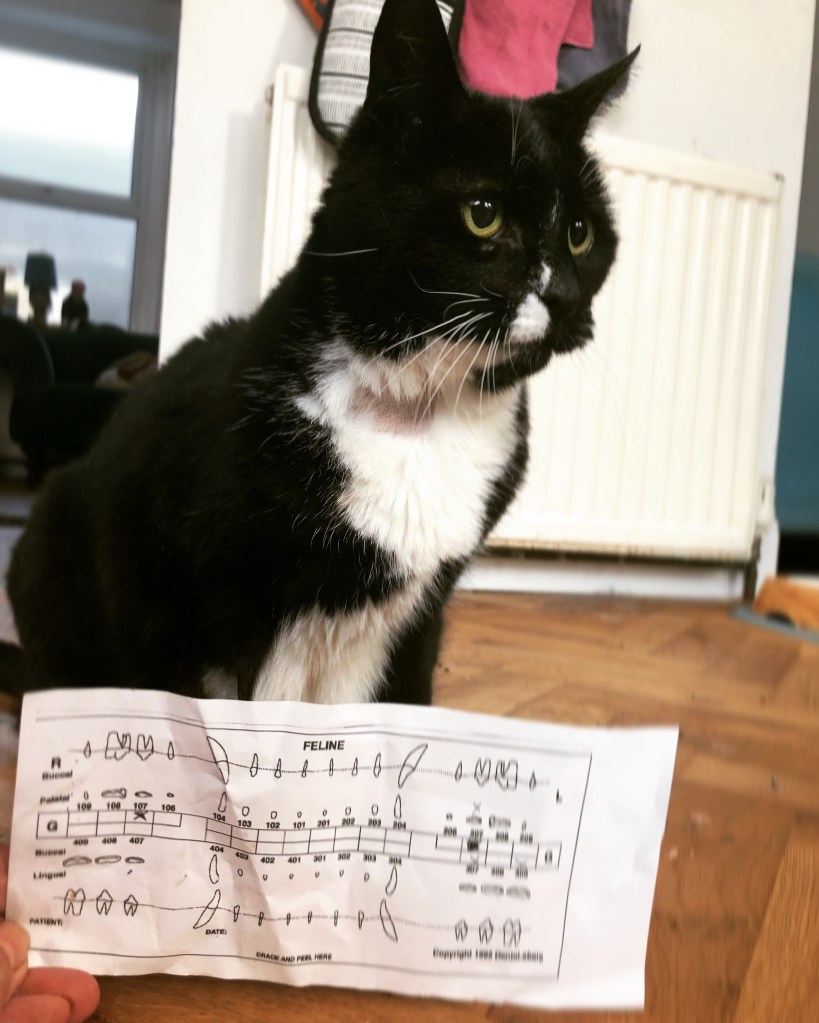
I took the day off work yesterday, dropped our elderly cat off at the vet for a dental operation, and scooted off to jump on a train to London, arriving only slightly late for a very interesting appointment at the Cartoon Museum.
A few weeks ago, I’d heard that a researcher was looking for comic artists to take part in an unusual project. Intrigued, I answered that call, and as it turns out, so did Zara Slattery, Woodrow Phoenix and Gareth Brookes, all of whom were sitting round a table with tea and biscuits when I apologetically stepped into the room and took my seat.
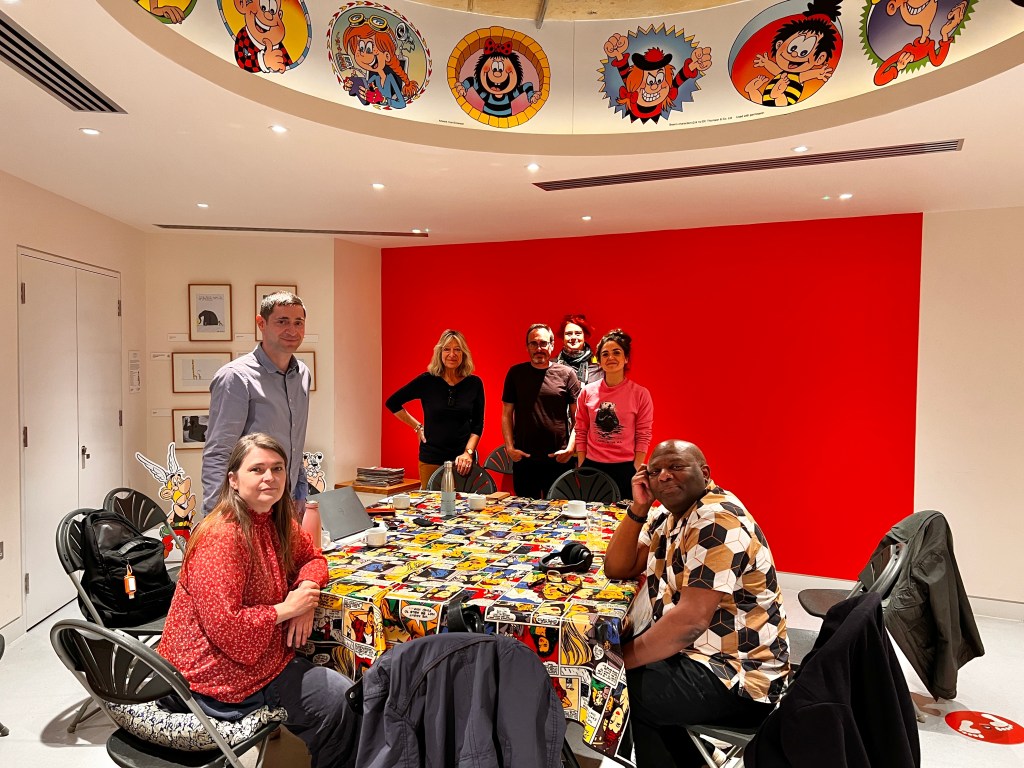
Also in the room were the researcher Dimitris Asimakoulas from the University of Surrey’s Centre for Translation Studies, Cartoon Museum curator Emma Stirling-Middleton, and ‘audio description expert’ Veronika Hyks. What would follow was a couple of hours of intensive discussion, and it was an absolute joy.
Dimitris is trying to discover whether the visual artform of comics can be made more accessible to blind and partially sighted audiences. As he put it in his original callout, “this will be a small project investigating the hypothesis that comic books have the capacity to affect the lives of diverse, non-elite audiences; taking this a bit further, I believe it is high time museums included descriptions for comic art that help blind or visually impaired audiences appreciate it (thus bringing them closer to museums and the art itself)”.
He’d sent us examples of audio descriptions of TV programmes as a starting point, and I’d arrived assuming that this was the idea we’d also be exploring for comics: could our work be made more accessible if there was a soundtrack describing it, frame by frame, in a gallery? In fact, the discussion, and the potential approaches we considered, were much broader in the end.
We answered some practical questions, like: what do we think people notice in our work when they are reading it? I had taken in this page as my example:
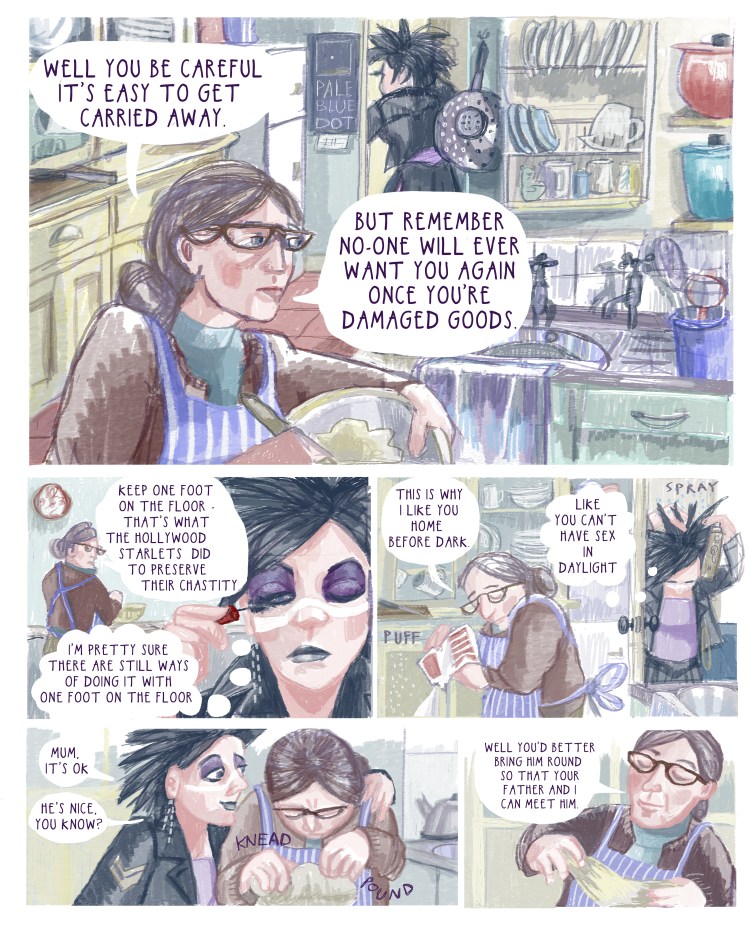
The question made me realise that as an artist, you might spend a long time drawing background details like pots and pans and plates; but some details are slightly more important to the piece than others. Like, some details are just there to make it clear it’s a kitchen – and an audio description could convey your hours of detailed drawing with the single word “kitchen” or perhaps slightly more detail (a well worn kitchen, a messy kitchen, a cluttered kitchen…); other details dotted through the book are trying to anchor it in a distinct time and place (in this case, Devon in the eighties). How much of this a reader would consciously take in depends, of course, on the individual: their knowledge of the world, their attention to detail; their willingness to stop and ponder.
And so the audio descriptor has a fine tuned task ahead of them: they can’t describe everything, because that would end up being very tedious for the person receiving their ‘aid’. The descriptor must attempt to convey the important details and perhaps somehow also get across the general atmosphere; the essence of what makes one strip different from another.
I think we ended up agreeing that while a blind or partially-sighted person can’t fully see a comic strip, they can be given an experience of it. This experience, however, might be something quite different or separate from the original strip. But given that every reader takes something different from a comic, that need not be a problem. Maybe it’s just a new piece of art in the world, related to the original, but something else in itself.
My own work was probably the most straightforward of that of the four artists taking part; and there was still plenty to discuss, from the changes in colour palettes in Satin and Tat‘s two timelines, to the sound effects, speech and thought bubbles, to the style of drawing, the characters’ expressions, and so on.
The others’ work opened up even more discussion. Zara deliberately chose to use different media for the different points of view in Coma – she spoke about a broken charcoal line talking of a certain fragility, for example, and the contrast of a bright white page after a spell of darker ones. She was also quite thoughtful about how one experiences leafing through a book, leaping in to the story, and how it is usually a private experience that you pace for yourself – it could be gobbled up in a day or consumed at a slow pace over a month or two.
Woodrow’s work is complex and graphic, but the page he brought in, from Rumblestrip, almost had a route mapped out on it and we wondered about that being made into a traceable road for a finger. He also mentioned that some of Schultz’s Peanuts books were manufactured with raised images and braille text for blind readers.
Finally, Gareth’s work was possibly the most pertinent out of all of ours: he’s known as an experimenter with form and over the years has produced comics that, while ending up as smooth images on the printed page, begin as very tactile media such as embroidery, scraped back wax crayon and pyrography. Plus, his book A Thousand Coloured Castles actually deals with macular degeneration. But, lovely though it is to trace a finger over embroidery thread to discover a figure, would the artist want their original artwork made grubby in this way? And would the reader even be able to follow a story just from touch?
Were we to create work knowing from the very start that it was for a blind or partially-sighted audience, I think we would all have made something very different, but it was fascinating to discuss ways we could make our existing stuff more accessible – and perhaps slightly shameful that we’d never even thought of doing so before.
In the next phases of the research, Veronika will be writing up descriptions of our exceprts and running them by us to see if we think they convey everything necessary; Emma will be looking into the practicalities of mounting accessible exhibitions; and Dimitris will be connecting with blind and partially-sighted people to find out more about how they would like to experience comics.
Anyway, the time flew: it was a real treat to be chewing over comics and how they are both created and consumed, and it cheered me up no end. I almost wished we could have talked for another couple of hours… but I had a disgruntled cat, minus three or four teeth, waiting for me at home.


 Myfanwy Tristram